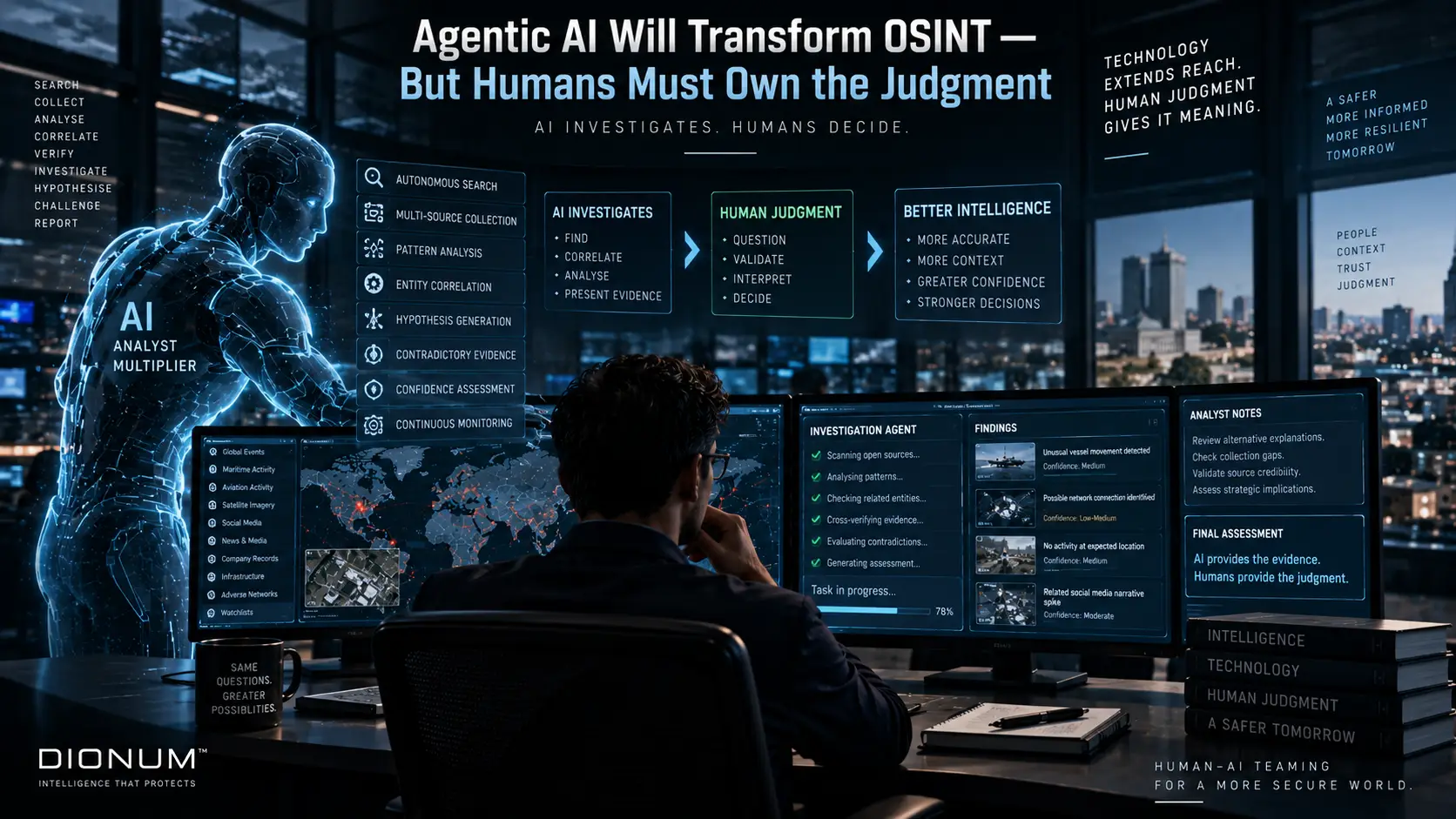
For years, the conversation around AI and OSINT has focused on automation.
Can AI collect information?
Can it translate documents?
Can it identify faces?
Can it classify images?
Can it summarise thousands of articles?
Can it detect patterns?
The answer to most of these questions is increasingly yes.
But something more significant is now emerging.
Agentic AI.
Instead of simply responding to an analyst’s request, an agent can potentially pursue a task across multiple steps.
It can search.
Collect.
Compare.
Correlate.
Investigate.
Generate hypotheses.
Look for contradictory evidence.
Return to the source.
Update its assessment.
And continue working while the analyst focuses on the larger question.
That could fundamentally change OSINT.
But there is a line that should not disappear in the process.
AI can own the workflow.
Humans must own the judgment.
From tools to agents
Traditional OSINT tools wait for instructions.
An analyst searches for a vessel.
The system returns results.
The analyst investigates a company.
The system retrieves records.
The analyst searches social media.
The system provides posts.
The human connects the dots.
Agentic systems change this relationship.
An analyst might instead ask:
“Investigate unusual activity involving this vessel during the last 30 days.”
An agent could potentially:
-
establish the vessel’s identity,
-
retrieve historical movement,
-
compare current behaviour against its baseline,
-
examine associated ownership,
-
identify related vessels,
-
search relevant public reporting,
-
examine satellite imagery,
-
identify unusual changes,
-
search for contradictory evidence,
-
construct a timeline,
-
assess confidence,
-
and present the evidence to the analyst.
That is a significant change.
The analyst is no longer operating a collection of tools.
The analyst is directing an investigative system.
OSINT has always had an attention problem
The fundamental constraint in intelligence has never been simply data.
It is human attention.
There are too many sources.
Too many languages.
Too many platforms.
Too many entities.
Too many events.
Too many relationships.
Too many things changing simultaneously.
The U.S. Intelligence Community’s OSINT strategy explicitly describes the mission in terms of delivering timely, relevant and insightful intelligence and calls for integrated collection management, innovation and a next-generation OSINT workforce.
Agentic AI could become one way of addressing the scale problem.
Instead of asking an analyst to manually inspect hundreds of sources, agents can perform the repetitive investigative work and bring forward the evidence that deserves human attention.
This is where the technology becomes genuinely interesting.
The analyst should ask questions, not operate software
Imagine an intelligence analyst investigating a developing situation.
Today, the analyst might open:
-
a maritime database,
-
a satellite platform,
-
a corporate registry,
-
a social-media search tool,
-
a news database,
-
a mapping platform,
-
a document repository,
-
and several specialist tools.
The analyst becomes the integration layer.
That is inefficient.
A mature agentic OSINT architecture should allow the analyst to ask:
“What changed?”
The system should determine which sources are relevant.
Another question:
“Who is connected to this entity?”
The system should investigate the relationship graph.
Another:
“Is this behaviour unusual?”
The system should compare it against historical patterns.
Another:
“What evidence contradicts our current assessment?”
The system should actively search for disconfirming information.
This is a much more natural way to interact with intelligence infrastructure.
Agentic AI changes the intelligence cycle
The traditional intelligence cycle is often represented as:
Direction → Collection → Processing → Analysis → Dissemination
Agentic AI can potentially operate across several of these stages.
A human provides the intelligence requirement.
The agent decomposes the requirement.
It identifies collection tasks.
It gathers information.
It processes and normalises it.
It correlates entities.
It identifies patterns.
It proposes analytical hypotheses.
It returns the evidence.
The human then evaluates the assessment and decides what it means.
This creates a new model:
Human intent → Agentic investigation → Evidence → Human judgment → Decision
That distinction is critical.
The agent is performing the investigation.
The human remains accountable for the assessment.
The danger is not that AI will make mistakes
AI will make mistakes.
That is already understood.
The more serious problem is plausible mistakes.
A bad search result is relatively easy to identify.
A confident, well-written, beautifully structured intelligence assessment containing one incorrect assumption is much more dangerous.
An agent could connect two entities because their names are similar.
It could interpret a correlation as causation.
It could trust a manipulated source.
It could propagate an incorrect assumption from one source into ten subsequent analytical steps.
And because the final output may look sophisticated, the error can become harder to notice.
This creates a new OSINT requirement:
Every important conclusion needs an evidence trail.
Agents need to show their work
An intelligence agent should not simply say:
Assessment: High likelihood of coordinated activity.
The analyst should be able to ask:
Why?
And the system should answer.
For example:
Assessment: Potentially coordinated activity
Evidence:
-
14 related accounts identified
-
9 created within a similar time period
-
7 use overlapping narrative language
-
4 share identical media assets
-
activity increased 620% within six hours
Contradictory evidence:
-
3 accounts have long-standing independent activity
-
no confirmed common operator
Confidence: Moderate
Key uncertainty: Attribution
Next investigative step: Examine cross-platform identity relationships.
That is explainable intelligence.
The agent does not demand trust.
It provides evidence that allows the analyst to exercise judgment.
The agent must know when to stop
This is an underrated problem.
An autonomous system can continue investigating indefinitely.
It can search another source.
Then another.
Then another.
It can generate another hypothesis.
Then another.
At some point, additional collection produces diminishing returns.
A good agent therefore needs an investigation boundary.
It should understand:
-
the objective,
-
the scope,
-
the available authorities,
-
the permitted data sources,
-
the confidence threshold,
-
the stopping conditions,
-
and when human intervention is required.
This is particularly important in sensitive intelligence environments.
NATO’s recent work on agentic AI explicitly highlights the need for human oversight, transparency, clear authority boundaries, accountability and traceability.
That is not bureaucracy around the technology.
It is part of the technology.
Human judgment is not simply the final approval button
There is a risk that “human in the loop” becomes a checkbox.
The AI does everything.
The human clicks approve.
That is not meaningful human oversight.
Human judgment needs to exist throughout the analytical process.
The analyst should be able to:
challenge the agent.
redirect it.
reject its assumptions.
change the investigation objective.
request alternative explanations.
inspect the evidence.
override the assessment.
And importantly:
stop the agent.
The human should remain the owner of the intelligence question.
Agents should argue with the analyst
One of the most useful future capabilities may be an AI system that does not simply agree with the analyst.
Suppose an analyst believes:
“This activity indicates preparation for an operational deployment.”
The agent should be capable of responding:
“Three observations support this hypothesis, but two alternative explanations remain plausible.”
Then:
“The strongest contradictory evidence is…”
And perhaps:
“The following observation would materially increase confidence in the original hypothesis.”
This is much more valuable than an AI assistant that simply produces polished summaries.
The objective should be better reasoning, not faster confirmation.
Agentic AI could make OSINT genuinely persistent
This connects directly to the idea of real-time OSINT.
A traditional analyst investigates when asked.
An agent can potentially maintain a continuous investigation.
Suppose a watchlist contains 500 entities.
The system can continuously monitor them.
When something changes, it investigates.
If the change is insignificant, it records it.
If it becomes meaningful, it escalates it.
If additional evidence appears, it updates the assessment.
If contradictory information emerges, it reduces confidence.
The intelligence picture becomes dynamic.
This is where agentic systems could have enormous value.
They can transform OSINT from:
“Search when needed.”
into:
“Investigate continuously within defined boundaries.”
But autonomy creates a new attack surface
There is another side to this discussion.
If an AI agent can collect, interpret and act across multiple information sources, then manipulating one of those sources can potentially influence the agent’s reasoning.
Synthetic information therefore becomes even more important.
An adversary does not necessarily need to attack the AI model itself.
They may attempt to influence the information environment the agent consumes.
A fabricated website.
A manipulated image.
A coordinated social narrative.
A compromised source.
A misleading document.
A false entity relationship.
The agent may process all of them perfectly.
And still arrive at the wrong conclusion.
This is why agentic OSINT must be built on information integrity, provenance and source evaluation.
The smarter the agent becomes, the more important the quality of its evidence becomes.
More autonomy requires more provenance
This may sound counterintuitive.
You might expect that a more autonomous system needs less human supervision.
In high-consequence intelligence environments, the opposite can be true.
The more steps an agent performs independently, the more important it becomes to preserve the chain of reasoning.
Where did this fact come from?
Which source did the agent trust?
What transformations were performed?
Which entities were resolved automatically?
Which assumptions were introduced?
Which sources were rejected?
What alternative hypotheses were considered?
What caused the confidence score to change?
This creates something close to an audit trail for intelligence reasoning.
That capability may become as important as the AI model itself.
The future OSINT platform will be multi-agent
The long-term architecture may not be one giant intelligence agent.
It may be a collection of specialised agents.
A Collection Agent finds relevant information.
A Verification Agent evaluates source quality and provenance.
A GEOINT Agent examines geographic evidence.
A MARINT Agent investigates maritime activity.
A SOCMINT Agent examines social networks.
A Entity Resolution Agent determines whether different records refer to the same entity.
A Temporal Analysis Agent reconstructs sequences.
A Contradiction Agent searches for disconfirming evidence.
A Fusion Agent brings the findings together.
And above them sits a human analyst.
The analyst does not need to manually coordinate every operation.
But the analyst remains responsible for the intelligence judgment.
The most powerful agent may be the one that says “I don’t know”
There is a tendency to measure AI systems by how many questions they can answer.
Intelligence requires another measurement:
How well does the system recognise uncertainty?
An agent should be comfortable saying:
“Evidence insufficient.”
Or:
“Sources conflict.”
Or:
“Entity identity cannot be established with confidence.”
Or:
“The apparent pattern may be explained by normal behaviour.”
Or:
“Further collection is required.”
That is not weakness.
It is analytical discipline.
A system that confidently answers every question may be less useful than one that knows when the evidence is insufficient.
The role of the analyst will change
Agentic AI will not necessarily make intelligence analysts less important.
It may make the best analysts more important.
The analyst of the future may spend less time searching.
Less time copying data.
Less time cleaning spreadsheets.
Less time translating documents.
Less time writing repetitive summaries.
More time defining intelligence requirements.
More time challenging assumptions.
More time evaluating competing hypotheses.
More time understanding context.
More time making judgments under uncertainty.
In other words:
Less information handling.
More intelligence thinking.
That is a worthwhile transformation.
The real competitive advantage will be human-machine teaming
The organisations that benefit most from agentic OSINT will probably not be those that simply deploy the most autonomous agents.
They will be those that design the best relationship between:
Human intent
Machine scale
Evidence
Reasoning
Oversight
Decision
NATO’s recent work reflects this direction. Its AI initiatives describe systems designed to accelerate processing and improve situational awareness while keeping human expertise and responsible-use principles central to operational decision-making.
The objective is not to remove humans from the intelligence process.
It is to give humans a much larger analytical field of view.
The final decision should remain human
There is a simple principle I would use when designing agentic intelligence systems:
Let the machine investigate.
Let the machine correlate.
Let the machine challenge.
Let the machine monitor.
Let the machine recommend.
But when the decision carries significant operational, strategic or human consequences:
Let the human own the judgment.
That does not mean slowing everything down.
Quite the opposite.
If the machine handles the enormous volume of information and the repetitive investigative work, the human can reach the important judgment faster.
That is the promise of agentic AI in OSINT.
Not replacing the analyst.
Not creating an autonomous intelligence authority.
But creating something closer to a digital investigative team that works continuously alongside human experts.
The next OSINT advantage
OSINT has moved through several stages.
First, the challenge was finding information.
Then it became verifying information.
Then connecting information.
Then understanding information in real time.
The next challenge is investigating information autonomously within controlled boundaries.
Agentic AI may become the technology that enables that transition.
But intelligence will never be only about what a machine can discover.
It will always depend on what a human is willing to believe, question, reject and ultimately decide.
The future OSINT platform should therefore not ask:
“How autonomous can we make the machine?”
A better question is:
“How much more capable can we make the human?”
That is where agentic AI can create its greatest value.
Machines can investigate at machine speed.
Humans must remain accountable for what the intelligence means.
And in the end, the most powerful intelligence system may not be the one that makes the most decisions.
It may be the one that gives humans the best evidence on which to make them.