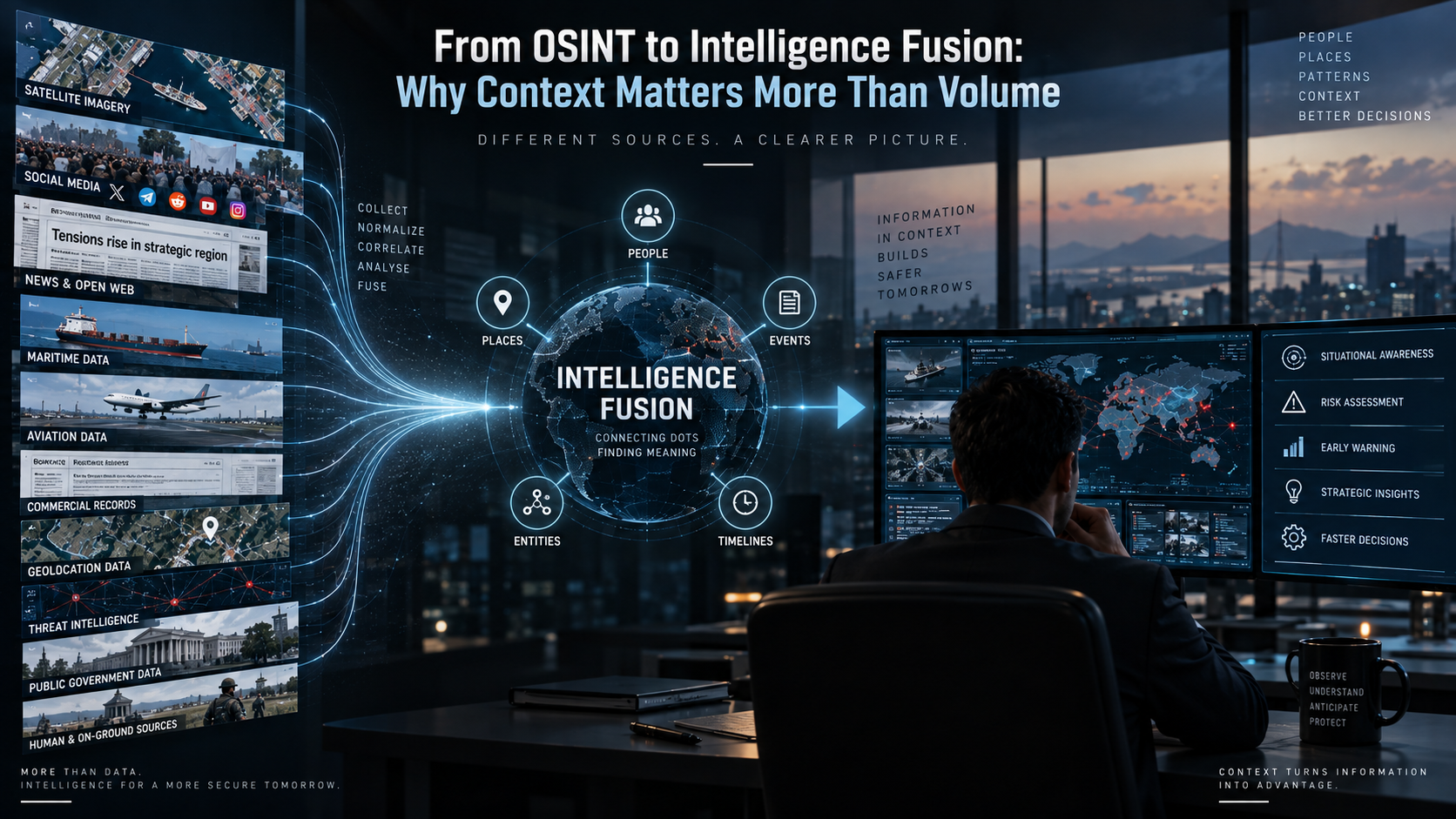
The OSINT industry has spent years celebrating numbers.
More sources.
More feeds.
More satellites.
More social media platforms.
More data points.
More alerts.
More dashboards.
But there is a question that deserves much more attention:
Does more information actually produce better intelligence?
Not necessarily.
In many operational environments, the opposite can happen.
When an analyst is confronted with thousands of alerts, hundreds of sources and an endless stream of new information, the problem is no longer collection.
The problem is context.
This is where the conversation needs to move from OSINT to intelligence fusion.
Data is not intelligence
It is easy to confuse the two.
A satellite image is data.
A vessel position is data.
A social media post is data.
A company registration is data.
A news report is data.
A radio transmission is data.
A flight track is data.
None of these becomes intelligence simply because it has been collected.
Intelligence emerges when information is evaluated, connected and placed within a meaningful context to answer a specific question.
That distinction is fundamental.
Consider a vessel changing its route.
On its own, that is an observation.
But suppose the same vessel:
- changed course outside its normal pattern,
- stopped transmitting its usual identifier,
- appeared near a strategically important location,
- was linked to a company that recently changed ownership,
- and was observed near another vessel with a related ownership structure.
Suddenly, the individual data points become much more interesting.
The intelligence is not in any one source.
It is in the relationship between them.
The problem with the “more data” mindset
Modern organisations have become extremely good at collecting information.
Cloud infrastructure makes storage cheap.
APIs make collection easier.
Commercial satellite constellations provide increasingly frequent imagery.
Social platforms generate enormous amounts of public information.
AI systems can process content at a scale that humans could never match.
This creates an attractive proposition:
If more information is available, collect more of it.
But intelligence analysis has a practical limit.
Human attention.
An analyst can only investigate a finite number of signals.
Every additional feed creates potential value—but also additional noise.
This creates what I would call the volume paradox:
The more information an organisation collects without improving its ability to contextualise it, the harder it can become to identify what actually matters.
A thousand irrelevant alerts do not create more intelligence than ten relevant ones.
They create ten relevant alerts hidden inside a thousand notifications.
Context changes the meaning of information
Information does not have a fixed meaning.
Its meaning depends on context.
A ship entering a port is ordinary.
The same ship entering the port after an unusual route deviation may be significant.
A new company registration is ordinary.
The same registration becomes more interesting if the directors are connected to several companies involved in a sensitive supply chain.
A sudden increase in social-media activity may simply reflect a popular news story.
Or it may indicate coordinated amplification.
The individual event has not changed.
Our understanding of the event has changed because additional context became available.
This is one of the central principles of intelligence fusion.
Intelligence fusion is about relationships
Traditional information systems are often organised around sources.
One database contains maritime information.
Another contains aviation.
Another contains social media.
Another contains company records.
Another contains satellite imagery.
Another contains cyber indicators.
The analyst is then expected to connect the dots.
That approach does not scale well.
The future intelligence architecture needs to treat the relationship between entities and events as a first-class object.
A vessel is connected to an owner.
The owner is connected to a company.
The company is connected to directors.
The directors are connected to other companies.
Those companies may be connected to ports, logistics providers, financial transactions or procurement activity.
At the same time, the vessel has a movement history.
The port has an activity history.
The region has a geopolitical history.
A social narrative may be developing around the same event.
Individually, these are separate datasets.
Together, they form an intelligence picture.
The intelligence graph
This is where graph-based approaches become particularly powerful.
Instead of asking:
“What does this source say?”
an intelligence system can ask:
“What is connected to this entity, event or activity?”
Imagine selecting a vessel on a screen.
The system immediately shows:
Vessel → Owner → Directors → Associated Companies → Previous Voyages → Ports → Cargo Indicators → Related Vessels → Satellite Observations → Social Narratives → Historical Events
The analyst can then move through the network.
This is much closer to how intelligence questions are actually investigated.
The world is not organised into databases.
It is organised into relationships.
Time is another dimension of context
Context is not only about relationships.
It is also about time.
An event that appears insignificant today may become important when viewed as part of a sequence.
For example:
Day 1: Company established.
Day 17: Director changes.
Day 31: New logistics contract appears.
Day 44: Vessel changes route.
Day 49: Satellite imagery shows activity at a particular facility.
Day 52: Related social-media narrative begins spreading.
None of these events necessarily proves anything by itself.
But the sequence deserves attention.
This is why intelligence systems need to understand temporal relationships, not just store timestamps.
The question is not simply:
What happened?
It is:
What happened before this, what happened after it, and what changed in between?
Context also means understanding what is normal
Anomaly detection sounds impressive.
But an anomaly is only meaningful when you know what normal looks like.
A vessel travelling through a particular area may be completely routine.
A sudden deviation from its historical pattern may be significant.
An account posting fifty times a day may be normal for that account.
A previously inactive account suddenly posting hundreds of coordinated messages may be unusual.
A facility may regularly show vehicle movement.
A sudden change in activity may deserve investigation.
Therefore, intelligence systems need baselines.
Without historical context, an alert is simply an observation with a red icon.
With historical context, it can become an analytical signal.
The missing layer: reasoning
This is where AI is likely to have an important role.
Modern AI systems can help process enormous amounts of unstructured information.
They can extract entities.
Translate languages.
Summarise documents.
Compare images.
Identify relationships.
Cluster narratives.
Detect anomalies.
But intelligence fusion requires something beyond extraction.
It requires reasoning over evidence.
Suppose an AI system identifies five pieces of information suggesting that two organisations are connected.
A useful intelligence system should not simply display:
“Connection detected.”
It should show:
- What evidence supports the connection?
- Which sources are independent?
- How recent is the evidence?
- What evidence contradicts it?
- Is the relationship direct or inferred?
- How confident is the assessment?
- What information would increase or decrease confidence?
That last question is particularly important.
A mature intelligence platform should not only tell analysts what it believes.
It should help them understand what they need to investigate next.
Intelligence fusion should preserve uncertainty
There is a temptation in technology products to simplify everything.
Green means safe.
Red means threat.
High confidence.
Low confidence.
True.
False.
Real.
Fake.
Operational intelligence rarely works that cleanly.
Sometimes the correct assessment is:
“We do not know yet.”
That is not a failure.
It is an analytical result.
A useful intelligence platform should therefore represent uncertainty rather than hide it.
For example:
Assessment: Possible coordinated information activity
Confidence: Moderate
Supporting evidence: 7 independent indicators
Contradictory evidence: 2 indicators
Key uncertainty: Attribution of originating account
Recommended investigation: Examine account creation history and cross-platform relationships
This is much more useful than a simple threat score.
Fusion reduces the distance between signal and decision
The real purpose of intelligence fusion is not to create beautiful dashboards.
It is to shorten the distance between:
Signal → Understanding → Decision
That distinction matters.
An analyst may discover a signal at 10:00.
By 11:00, the signal has been correlated with other events.
By 11:15, its historical context is understood.
By 11:30, competing explanations have been examined.
By noon, decision-makers have a concise assessment supported by evidence.
That is intelligence advantage.
The value is not that the organisation collected more information.
The value is that it understood the information faster and with greater context.
The future OSINT platform will become an intelligence fabric
I expect the boundaries between OSINT, GEOINT, MARINT, SOCMINT, cyber intelligence and commercial intelligence to become increasingly blurred.
The analyst should not have to care which database contains the answer.
The system should.
The analyst should be able to ask:
“Show me unusual maritime activity connected to entities associated with this organisation during the last 90 days.”
Or:
“What changed around this facility during the last six months?”
Or:
“Which narratives appeared online before the physical event?”
Or:
“Show me all entities connected to this organisation through two or fewer relationships.”
Those are intelligence questions.
They are not database queries.
The infrastructure underneath may involve dozens of sources.
But the analyst experiences one intelligence environment.
That is the direction in which I believe OSINT platforms will evolve.
Volume will become a commodity
Collection itself is becoming easier.
That means raw information will increasingly become commoditised.
The competitive advantage will move elsewhere.
Context.
Correlation.
Provenance.
Historical understanding.
Entity resolution.
Pattern recognition.
Analytical reasoning.
And ultimately:
decision relevance.
The organisations that understand this transition will build systems that do not simply collect more.
They will build systems that understand more.
The question is no longer “How much data do we have?”
It is:
“How much meaning can we extract from the data we already have?”
That is the transition from OSINT to intelligence fusion.
OSINT gives us access to an enormous information environment.
Fusion gives those signals relationships.
Context gives them meaning.
Analysis gives them relevance.
And decision-makers ultimately need something even more valuable:
confidence about what deserves their attention.
The next generation of intelligence infrastructure will therefore not be defined by how many sources it connects.
It will be defined by how effectively it connects the right information, at the right time, in the right context.
Because in intelligence, more information is not necessarily more power.
Understanding is.