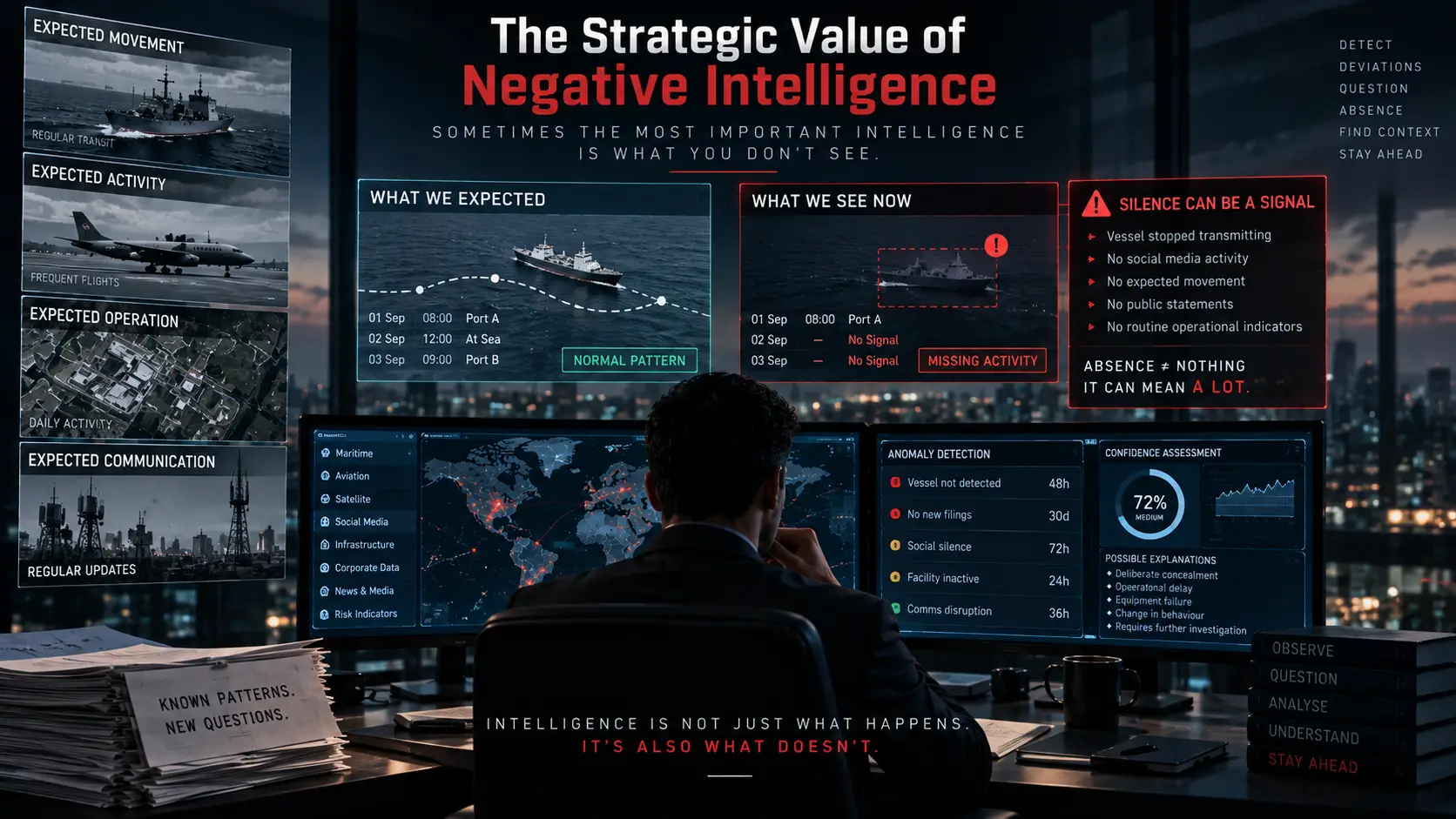
Intelligence is usually built around what we can see.
A satellite image shows activity.
A vessel appears on a tracking system.
A social-media account publishes a message.
A company files a document.
A news organisation reports an event.
An aircraft changes its route.
These are visible signals.
But sometimes the most important intelligence is not what appears.
It is what should have appeared but did not.
A vessel disappears from its normal tracking pattern.
A normally active account suddenly becomes silent.
A facility that usually shows regular activity becomes unusually quiet.
A public announcement that would normally accompany an event never appears.
A known network stops communicating.
A scheduled movement does not happen.
There may be no obvious “event.”
Yet the absence itself can be a signal.
This is the strategic value of negative intelligence.
Absence is not automatically intelligence
There is an important distinction at the beginning.
Missing information does not automatically mean something happened.
A vessel may stop transmitting because of equipment failure.
A social-media account may become inactive because its owner stopped using it.
A satellite image may fail because of cloud cover.
A government document may simply be delayed.
Silence can have many explanations.
Therefore, negative intelligence should not mean:
“We did not observe something, therefore something must be wrong.”
It means:
“Something expected is absent, and that absence may be analytically significant.”
That is a much more disciplined approach.
The intelligence comes from the deviation between expected behaviour and observed behaviour.
The intelligence value of “nothing”
Consider a simple example.
A particular vessel normally broadcasts its position regularly.
For months, its behaviour is predictable.
Then the transmissions stop.
If an analyst only looks for positive events, there may be nothing to report.
No new location.
No new message.
No new photograph.
No new announcement.
But if the system understands the vessel’s historical behaviour, the absence becomes visible.
The important question becomes:
Why did the expected signal disappear?
That question can trigger further investigation.
Was the vessel deliberately operating without its usual identifier?
Did it enter an area with poor coverage?
Did another sensor continue to observe it?
Did its associated vessels behave differently?
Did its ownership or cargo information change?
Did anything else unusual happen at approximately the same time?
The absence becomes the starting point for intelligence collection.
Intelligence is often about deviations from expectation
This is where negative intelligence connects directly with behavioural analysis.
You cannot identify a meaningful absence unless you understand what normally happens.
That requires a baseline.
For example:
A facility normally operates six days a week.
A particular aircraft normally flies a predictable route.
A company regularly publishes regulatory information.
A social-media account posts every day.
A vessel normally reports its location at regular intervals.
A logistics network follows a relatively stable pattern.
Once that baseline exists, the system can identify deviations.
And deviations can be positive or negative.
Something appeared that should not have appeared.
Or:
Something disappeared that normally should have appeared.
Both can matter.
Silence can be structured
The most interesting cases are not necessarily complete silence.
They are selective silence.
Imagine a company that normally publishes information across several channels.
Its website remains active.
Its social-media accounts remain active.
Its public communications continue.
But one particular category of information suddenly disappears.
That may be more interesting than total inactivity.
Similarly, an information operation may continue posting content while specific keywords, locations or subjects disappear from the narrative.
The question is no longer:
“Are they active?”
It becomes:
“What are they no longer talking about?”
This is a much more sophisticated intelligence question.
The missing connection can matter
Negative intelligence can also exist in relationships.
Suppose analysts expect two organisations to interact regularly.
Their historical relationship is well documented.
Suddenly, the expected interaction stops.
No new contracts.
No public announcements.
No shared personnel movement.
No obvious communication.
Again, this does not prove anything.
But the missing relationship can become an investigative signal.
Perhaps the organisations have separated.
Perhaps the relationship has moved into a less visible channel.
Perhaps the underlying activity has changed.
Or perhaps nothing meaningful has happened at all.
The point is that the absence creates a question.
Good intelligence systems should be able to identify those questions.
The hardest intelligence question may be “What should we be seeing?”
This is where traditional OSINT systems often have a limitation.
Most systems are designed to collect what exists.
Search engines return what they find.
Feeds provide what they receive.
Databases store what is recorded.
But intelligence analysis sometimes requires something different.
The system needs to understand what should exist.
That requires models of normal behaviour.
It requires historical data.
It requires entity relationships.
It requires temporal patterns.
And it requires an understanding of the information environment itself.
Only then can a system distinguish between:
No information exists
and
Information should exist, but it is missing.
Those are very different situations.
Negative intelligence and the problem of visibility
There is another important concept: collection visibility.
Not seeing something does not necessarily mean that it does not exist.
An analyst might fail to observe an event because:
- the relevant sensor did not cover the area,
- the source stopped publishing,
- the platform changed its API,
- the account became private,
- imagery was unavailable,
- the data was delayed,
- or the information was never publicly exposed.
This means every negative assessment should consider the possibility of a collection gap.
A mature intelligence platform should therefore distinguish between:
Observed absence
and
absence of observation.
That distinction is fundamental.
If a satellite covers an area and shows no vehicles, that is different from having no satellite coverage.
If a vessel’s transponder is active but no position is received, that is different from the vessel being outside coverage.
If a normally active website has not published a particular document, that is different from having no access to the website.
Negative intelligence requires this level of discipline.
Silence can become a signal when multiple systems agree
One of the strongest forms of negative intelligence emerges through cross-domain correlation.
Imagine:
A vessel stops transmitting.
Satellite imagery shows no activity at its expected destination.
Associated vessels also change behaviour.
Public reporting becomes unusually quiet.
At approximately the same time, related corporate information changes.
None of these observations proves a particular explanation.
But the combined absence of expected signals across multiple domains can become significant.
This is where intelligence fusion becomes important.
The question is not:
“Why is this one source silent?”
It becomes:
“Why did several expected signals disappear simultaneously?”
That is a much stronger analytical question.
Negative intelligence can be strategically valuable
There are situations where the absence of activity itself provides useful information.
An expected military movement does not occur.
A planned public communication does not appear.
A previously active network becomes quiet.
A supply chain stops producing its usual digital footprint.
A particular narrative disappears from a coordinated information environment.
A facility becomes less active than historical norms would suggest.
Again, none of these observations should automatically be interpreted as hostile or intentional.
But they can affect an assessment.
Sometimes the absence of activity can suggest:
delay.
concealment.
disruption.
operational change.
strategic restraint.
deception.
Or simply:
nothing happened.
The analytical challenge is determining which explanation is best supported by the available evidence.
AI can make negative intelligence much more practical
Negative intelligence has traditionally been difficult because humans are poor at continuously remembering baselines across thousands of entities.
AI and machine-learning systems can help.
A system can learn historical patterns for:
- vessel movement,
- aircraft behaviour,
- social activity,
- website publishing,
- company activity,
- infrastructure changes,
- communication patterns,
- narrative activity,
- and other observable behaviours.
It can then identify deviations.
Not only:
“Something happened.”
But:
“Something expected did not happen.”
That creates an entirely different class of alerts.
For example:
Expected activity missing
Facility normally shows activity every weekday between 06:00–18:00. No comparable activity observed today. Satellite coverage confirmed. Confidence: moderate.
Or:
Communication pattern deviation
Entity normally publishes regulatory notices monthly. No publication observed for 67 days. Historical pattern suggests this is unusual.
The system is not claiming to know the reason.
It is identifying a meaningful deviation.
That is exactly where human analysis becomes valuable.
Negative intelligence is also about asking better questions
The strongest intelligence analysts are not simply people who find information quickly.
They know how to ask:
What is missing?
What should be here?
What changed?
What stopped?
Who became silent?
Which relationship disappeared?
Which narrative suddenly went quiet?
Which expected event did not occur?
These questions can expose information that a conventional search-driven workflow may never surface.
The danger of overinterpreting silence
There is, however, a major analytical trap.
Humans are naturally uncomfortable with uncertainty.
When information disappears, we tend to create explanations.
That is dangerous.
Silence can be meaningful.
But silence can also be ordinary.
A good intelligence system should therefore resist the temptation to convert every absence into a threat.
Instead, it should present the absence together with context:
Expected behaviour
Observed behaviour
Collection coverage
Historical frequency
Alternative explanations
Confidence
Additional evidence required
This turns negative intelligence into a disciplined analytical method rather than speculation.
From anomaly detection to expectation management
This suggests a broader evolution in intelligence technology.
Traditional systems ask:
“What is happening?”
Advanced systems ask:
“What is unusual?”
The next generation should also ask:
“What should be happening—and isn’t?”
That is a much harder problem.
It requires the system to maintain an evolving model of the environment.
Every entity has a history.
Every network has relationships.
Every location has patterns.
Every information source has behaviour.
Every operational environment has expectations.
Intelligence emerges when reality deviates from those expectations.
The strategic advantage may be in what nobody is talking about
In a world overflowing with information, attention naturally moves toward visible events.
Breaking news.
Viral posts.
New satellite imagery.
Major announcements.
Large movements.
But strategic intelligence often requires looking in the opposite direction.
What is quiet?
What disappeared?
What stopped?
What did not happen?
What information should exist but does not?
Sometimes the most important signal is not a new piece of information.
It is the missing piece.
The future of OSINT will need to understand absence
The next generation of intelligence platforms should not be designed only as information collectors.
They should become expectation engines.
They should learn what normal looks like.
Track what changes.
Identify what disappears.
Measure the significance of missing signals.
Cross-check collection coverage.
Surface competing explanations.
And give analysts a structured way to investigate the unknown.
Because intelligence is not simply the ability to see more.
It is the ability to recognise when reality does not look the way it should.
And sometimes, the most important intelligence is hidden in a very simple observation:
Nothing happened.
The real question is:
Was something supposed to happen?
That is where negative intelligence begins.