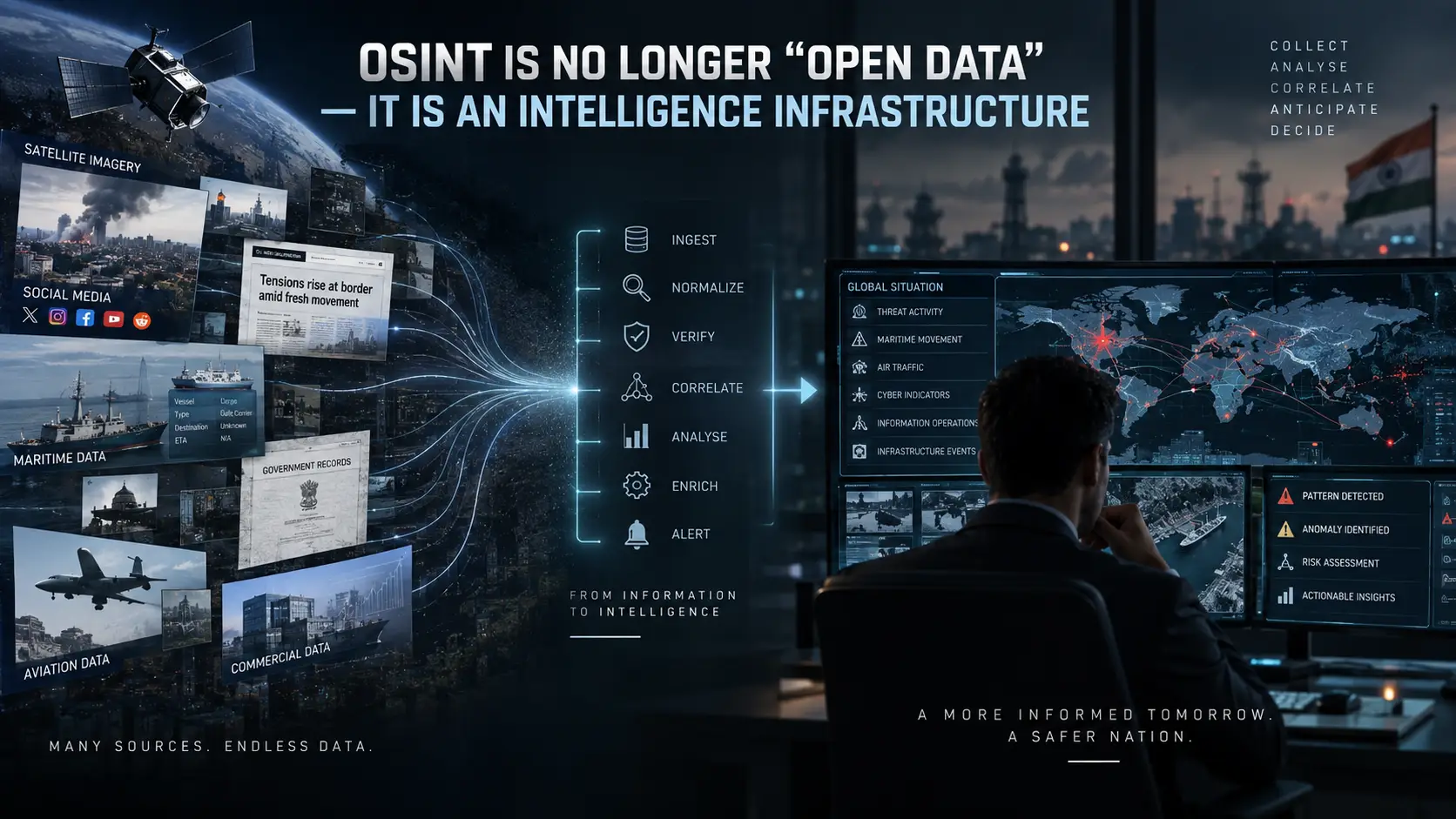
OSINT Is No Longer “Open Data” — It Is an Intelligence Infrastructure
For a long time, OSINT was explained in a fairly simple way: information that is publicly available.
- A website
- A satellite image.
- A social media post.
- A flight-tracking platform.
- A government document.
- A leaked database.
- A photograph uploaded by someone at the right place and the right time.
Put enough of these together and you have OSINT.
That definition is no longer sufficient.
The real challenge today is not finding information. There is too much of it.
The challenge is deciding what matters, establishing whether it is trustworthy, understanding how different pieces of information are connected, and turning those connections into something a decision-maker can actually use.
That is why I believe OSINT is moving into a different category.
OSINT is becoming intelligence infrastructure.
The internet has changed the collection problem
The amount of information available to analysts has grown at a speed that traditional intelligence workflows were not designed to handle.
A single event can generate thousands of digital traces within minutes: social media posts, videos, satellite imagery, vessel movements, flight data, company records, domain registrations, photographs, local news reports, government notices and commercial datasets.
Individually, many of these pieces appear insignificant.
Together, they can reveal a pattern.
Consider a simple example.
A vessel changes its usual route.
A few hours later, a port-related company makes an unusual regulatory filing.
At approximately the same time, satellite imagery shows activity around a facility that normally has little movement.
Separately, social media posts begin appearing from people in the area.
None of these signals necessarily means anything by itself.
But intelligence rarely comes from one signal.
It comes from correlation.
That is where the modern OSINT problem begins.
Search is not intelligence
One of the biggest misconceptions about OSINT is that better search produces better intelligence.
Search is only the beginning.
An analyst may find hundreds of relevant documents and still have no intelligence picture.
The difficult questions come afterwards:
- Who published the information?
- When was it published?
- Is the original source still available?
- Has the information been copied elsewhere?
- Are multiple sources actually repeating the same original claim?
- What information is missing?
- Can the location be independently verified?
- Does the timeline make sense?
- What other events occurred around the same time?
- Is there evidence that contradicts the initial hypothesis?
This distinction matters.
Information retrieval is not intelligence analysis.
The modern OSINT stack therefore needs more than search engines and collection tools. It needs provenance, verification, correlation, temporal analysis, geospatial context, entity resolution and human analytical judgment.
The U.S. Intelligence Community’s 2024–2026 OSINT Strategy reflects this shift. It describes OSINT as intelligence derived from publicly or commercially available information that addresses specific intelligence priorities, requirements or gaps. More importantly, the strategy calls for coordinated acquisition, integrated collection management, innovation and a next-generation OSINT workforce.
That language is important.
It is the language of an enterprise capability, not simply a collection of websites.
The fragmentation problem
Ironically, the open information ecosystem has become more difficult to work with as it has become larger.
An analyst may need one platform for satellite imagery, another for maps, another for aircraft, another for vessels, another for social media, another for company records and another for historical archives.
Then there are dozens of specialist tools sitting between them.
Bellingcat’s experience illustrates this problem particularly well. Its 2024 Online Investigations Toolkit was developed partly because researchers were struggling to identify and keep track of the rapidly changing collection of tools available for open-source investigations.
This creates an interesting paradox:
We have more information than ever, but the information environment itself is becoming harder to navigate.
The problem is no longer simply access.
It is integration.
From sources to signals
This is where I see the next generation of OSINT platforms developing.
The unit of value should not be the individual source.
It should be the signal.
A useful intelligence system should be capable of taking thousands of apparently unrelated observations and asking:
What changed?
What is connected?
What is unusual?
What is developing?
What should an analyst investigate next?
This requires a fundamentally different architecture.
Instead of building a platform around a list of data sources, the platform should be built around an intelligence workflow.
Collect → Normalize → Verify → Correlate → Analyse → Prioritize → Alert → Explain
That sounds straightforward.
In practice, it is extremely difficult.
Every stage introduces its own challenges.
Data can be incomplete.
Sources can disappear.
Entities can have multiple identities.
Locations can be ambiguous.
Timestamps can be wrong.
Algorithms can amplify noise.
Human analysts can introduce confirmation bias.
The system therefore cannot simply produce more information.
It has to produce better context.
Trust becomes part of the infrastructure
As OSINT becomes more operational, provenance becomes increasingly important.
An intelligence product should be able to answer a basic question:
“Why should I believe this?”
That means preserving the source, timestamp, collection method, transformations and analytical reasoning behind an assessment wherever practical.
This is particularly important when information may eventually be used for serious decisions.
Bellingcat’s investigative methodologies provide a useful example. Their approach places significant emphasis on documenting sources, preserving digital evidence and creating a methodology that allows findings to be independently examined.
This principle extends beyond investigative journalism.
If OSINT is going to support national security, critical infrastructure, corporate security or strategic decision-making, traceability cannot be an optional feature.
It has to be part of the architecture.
AI will change OSINT — but it will not replace the analyst
Artificial intelligence will dramatically increase the scale at which OSINT can operate.
Machines can process enormous volumes of text, images, video and structured data.
They can identify entities.
They can translate languages.
They can cluster similar events.
They can detect anomalies.
They can monitor changes over time.
They can generate summaries.
But there is an important distinction between finding a pattern and understanding what the pattern means.
An AI system may identify that two events are correlated.
That does not automatically establish causation.
It may identify an unusual movement.
That does not explain the intent behind it.
It may detect a narrative spreading rapidly online.
That does not necessarily establish who created it or why.
This is why the future of OSINT is unlikely to be “AI replaces analysts.”
It is more likely to be:
AI expands the analyst’s field of view.
The analyst remains responsible for questioning the evidence, testing competing explanations and deciding what deserves attention.
The information environment is now part of the battlefield
There is another reason this transformation matters.
Information itself has become an operational environment.
States, militaries, companies, criminal networks, activists, journalists and ordinary citizens all leave digital traces.
At the same time, actors can deliberately create information to influence perception.
This makes the distinction between information collection and information environment analysis increasingly important.
NATO has explicitly identified hostile information activities, including information manipulation and interference, as part of the broader security environment and emphasizes the importance of tracking and analysing such activity to understand the behaviour of hostile actors.
In that environment, OSINT is not simply about answering:
“What happened?”
It increasingly has to help answer:
“What is happening, who is involved, what is changing, and what could happen next?”
That is a very different requirement.
The next OSINT platform will look less like a search engine
I believe the future OSINT platform will increasingly resemble an intelligence operating layer.
Behind the interface, it will connect multiple information domains:
OSINT + GEOINT + SOCMINT + commercial data + imagery + maritime data + aviation data + cyber indicators + infrastructure data + historical intelligence
The objective will not be to expose every piece of information to the analyst.
The objective will be to reduce the distance between signal and understanding.
A commander should not need to open fifteen browser tabs to understand a developing situation.
A security team should not have to manually compare yesterday’s information with today’s.
An intelligence analyst should not spend most of the day moving data between disconnected tools.
The infrastructure should do more of that work.
The analyst should spend more time asking better questions.
From dashboards to decision advantage
This is perhaps the biggest change.
The value of OSINT should not be measured by the number of sources connected to a platform.
Nor should it be measured by how many alerts it generates.
A system that produces 50,000 alerts a day has not necessarily created intelligence.
It may have created another problem.
The real question is:
Did the system help someone make a better-informed decision, earlier?
That is the standard I believe OSINT platforms should increasingly be measured against.
Not data volume.
Not dashboards.
Not the number of integrations.
Decision advantage.
OSINT has entered its infrastructure era
The first generation of OSINT was largely about discovery.
The second generation became focused on investigation and verification.
The next generation will be about persistent intelligence infrastructure.
Infrastructure that continuously observes.
Continuously learns.
Continuously correlates.
Continuously preserves evidence.
And continuously presents the information that matters.
The open internet has effectively become a gigantic, constantly changing sensor network.
But sensors alone do not create intelligence.
The intelligence comes from how those signals are collected, connected, verified, interpreted and delivered.
That is why I would no longer describe OSINT simply as “open data.”
Open data is the raw material.
OSINT is the intelligence process.
And increasingly, the infrastructure connecting the two may become one of the most important layers in modern intelligence.
References & further reading
- Office of the Director of National Intelligence — IC OSINT Strategy 2024–2026
The U.S. Intelligence Community’s strategy for modernising OSINT collection, integration, innovation and workforce development. - NATO — AJP-2.1 Intelligence Procedures
Provides NATO’s doctrinal treatment of OSINT within the broader intelligence architecture. - NATO — Approach to Counter Information Threats
Useful background on the changing information environment and the role of analysis in understanding information threats. - Bellingcat — Online Investigations Toolkit
A practical illustration of the growing and fragmented OSINT tooling ecosystem. - Bellingcat / GLAN — Justice & Accountability Methodology
A useful reference for source verification, evidence preservation, transparency and reproducibility in open-source investigations. - Bellingcat — Seven Deadly Sins of Bad Open Source Research
A valuable reminder that having access to information and tools does not automatically produce reliable intelligence.